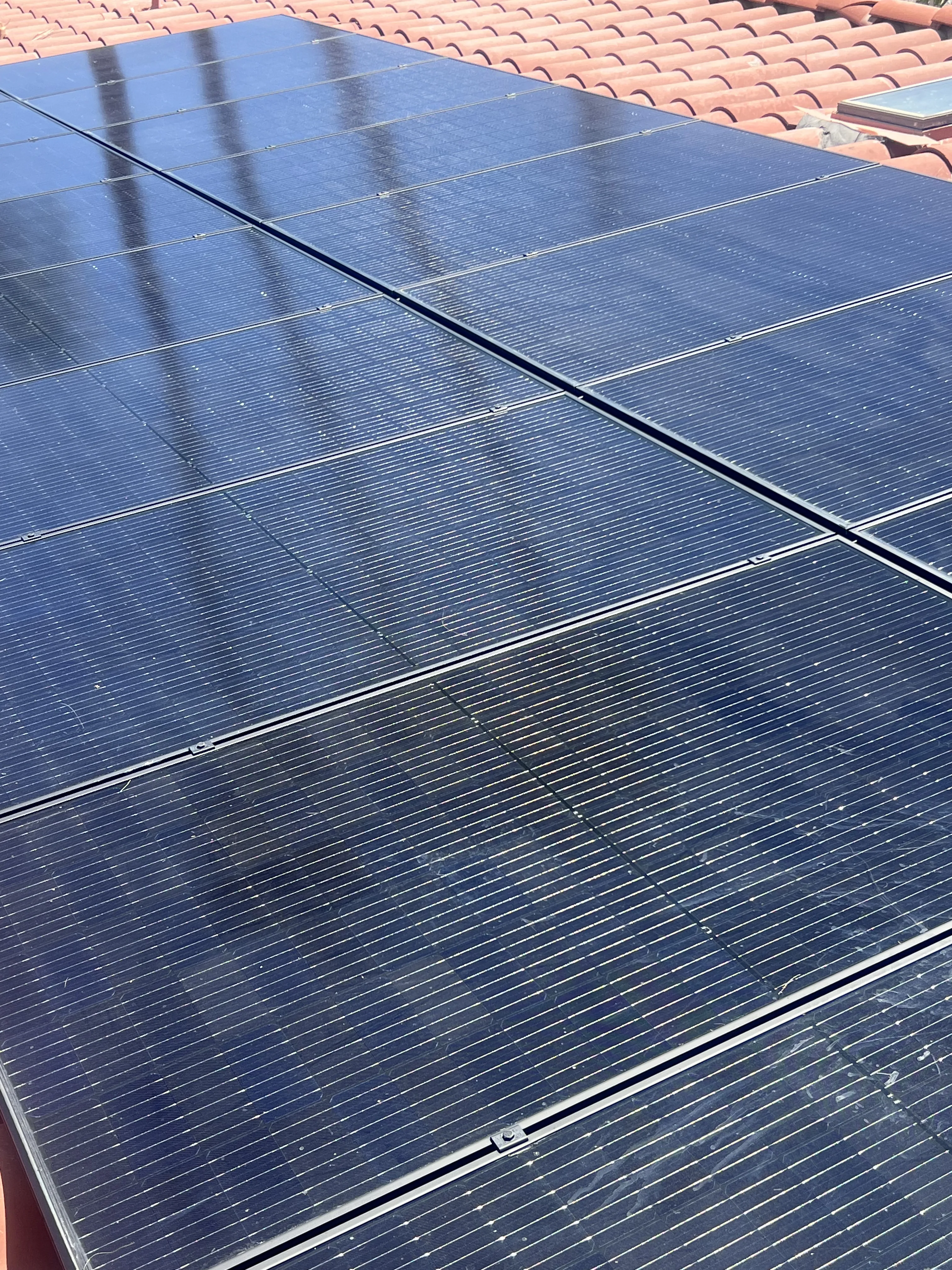
If you live anywhere from Palm Springs to La Quinta, the manufacturer’s recommendation — “clean your panels once or twice a year” — is wrong for your roof. It’s a national average written for a country where most solar lives in places that get real rain.
The Coachella Valley does not get real rain. Here’s what the inverter data actually says, and the cadence we recommend by zone.
The short answer
For most homes in the valley:
- Standard cadence: every 4 months (3× per year)
- Aggressive cadence: every 3 months (4× per year) if you’re west-valley, near the pass, or downwind of construction or agriculture
- Minimum to stay ahead of warranty soiling: every 6 months (2× per year)
For commercial roofs, the math usually pushes harder — most warehouses and retail sites we service are on quarterly contracts, and a few high-soiling sites run bimonthly.
Why “twice a year” doesn’t work here
The standard recommendation assumes seasonal rain washes panels for free between professional cleans. That’s roughly true in San Diego or the Bay Area. It’s not true here.
A few realities of valley solar:
- Total annual rainfall is around 3–4 inches — and most of that comes in short bursts that leave more dust on the glass than they wash off (the wet-dry cycle bakes mineral residue onto the panel surface).
- Prevailing westerlies through the San Gorgonio Pass carry fine silica grit from the desert floor across the valley year-round.
- Monsoon season (July through September) drops dust storms that can layer arrays in a single afternoon.
- Agricultural sources in the east valley add organic particulate on top of the silica.
The combined effect: a panel here can lose 8–15% of its output within two to three weeks of a clean, and the loss keeps climbing the longer you wait.
What the inverter data shows
You don’t have to take our word for it. Pull up your monitoring app (Enphase, SolarEdge, Tesla — they all do this) and look at daily production over the last six months. If you’ve never had a professional clean, you’ll usually see one of two patterns:
- A slow downhill drift of 10–20% from peak production to current. That’s accumulated soiling. A single clean typically recovers most of it overnight — we routinely see same-day production jumps of 12–18% on systems that hadn’t been cleaned in over a year.
- A choppy line that drops after every dust event and recovers slightly after every rain. That’s a more honest pattern — the panels are partially self-washing — but the average is still 6–10% below where it should be.
Either way, the data tells you the same thing the dust on the glass tells you: more cleans than the manufacturer suggests.
Cadence by zone
We fly across the whole valley, and soiling rates are not the same everywhere. Roughly:
Faster soiling — clean every 3 months:
- Palm Springs (silica through the pass, especially Movie Colony and Uptown)
- Cathedral City (dual exposure from pass winds and east-valley sources)
- Desert Hot Springs (open exposure, frequent dust events)
- Anything within a half-mile of an active construction site
Standard cadence — clean every 4 months:
- Rancho Mirage, Palm Desert, Indian Wells
- Most of La Quinta and Bermuda Dunes
- Anything sheltered behind hills or established neighborhoods
Slower soiling — clean every 5–6 months:
- Sheltered estate lots with mature landscaping that breaks the wind
- Carport structures with rear walls that block westerly grit
Your installer probably told you “once or twice a year.” For most of these ZIPs, that’s leaving real money on the roof.
Dust events change the math
Above the baseline cadence, watch for trigger events that warrant an unscheduled clean:
- A monsoon dust storm with measurable accumulation (you can see it on the panels from the ground).
- A nearby construction project kicking up grit for weeks.
- Wildfire ash drift — fine ash bonds harder than dust and needs to come off quickly.
- A sudden drop in monitored production that doesn’t recover within a week.
A trigger-event clean isn’t an upsell — it’s the cheapest way to keep a 25-year asset producing at spec.
Commercial cadence is its own conversation
Quarterly is the default for commercial roofs in the valley, but the right cadence depends on your kWh recovery curve. We model it like this:
- Measure soiling loss between visits (we use reference cells where the site allows, otherwise inverter-data deltas).
- Convert to lost dollars at your blended utility rate.
- Compare to the marginal cost of a more frequent visit.
For most commercial sites we’ve modeled, quarterly beats semi-annual on dollars recovered. A few high-soiling sites (open desert exposure, near unpaved access roads) actually pencil for bimonthly. We’ll do the math against your site before recommending a cadence — if more frequent cleaning doesn’t pay for itself, we’ll say so.
What to do next
If you’ve never had your system professionally cleaned, or if it’s been more than 6 months, the first clean usually pays for itself in production recovery within weeks. After that, get on a cadence — your future self (and your inverter) will thank you.